Our State
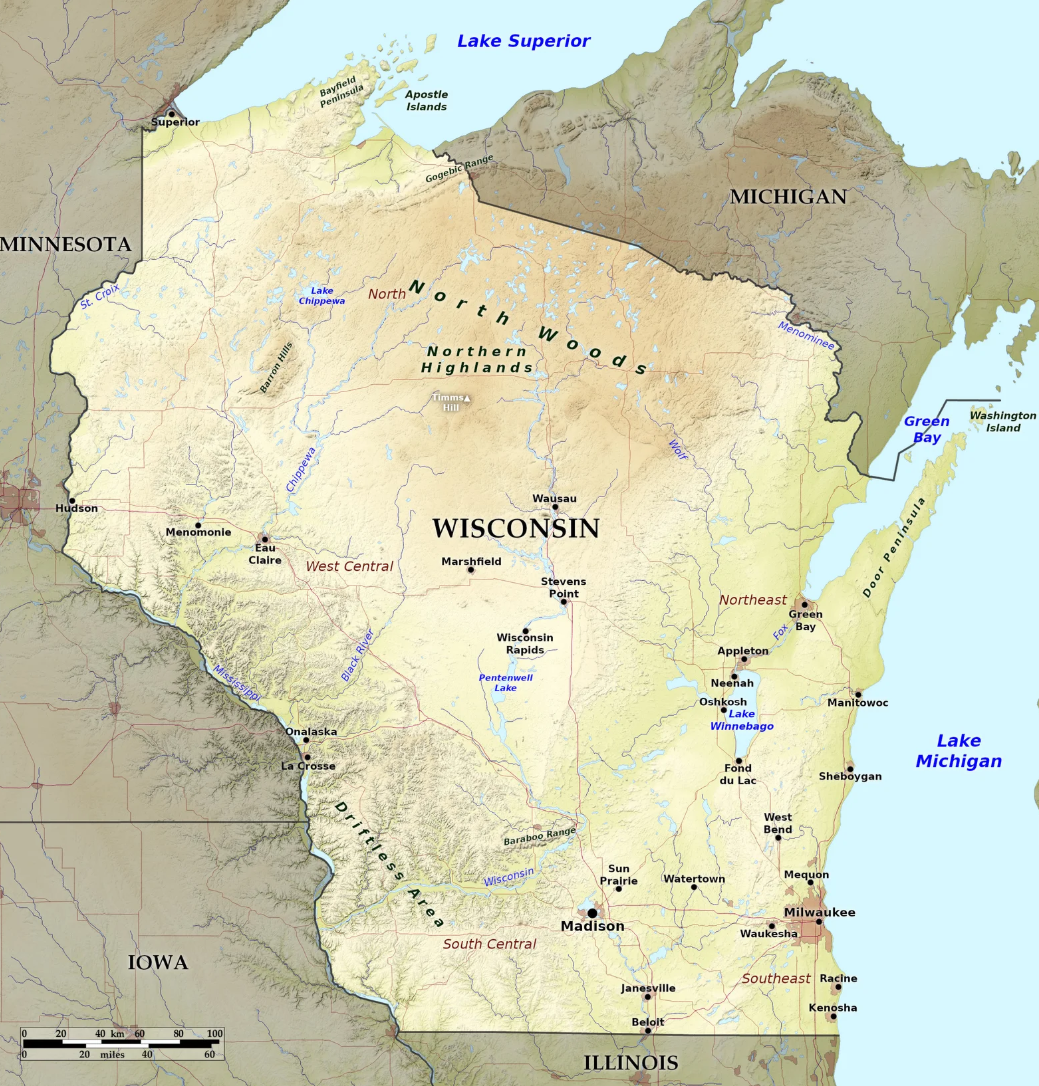
Map of Wisconsin and Counties


Wisconsin Genealogy Trails History Group
© Genealogy Trails 2026. All data on this website is Copyright by Genealogy Trails with full rights reserved for original submitters.
1836 – 1848
Wisconsin Was Originally Part of the Northwest Territory
Territorial History: The region was originally part of the Northwest Territory and became the Wisconsin Territory in 1836.
Path to Statehood: Despite a population exceeding the required 60,000, residents voted against statehood multiple times due to fears of higher taxes. A second constitutional convention produced an acceptable constitution in early 1848.
Admission: President James K. Polk signed the bill admitting Wisconsin into the Union, making it the last state formed entirely from the original Northwest Territory.

Wisconsin Territory 1836 – 1848
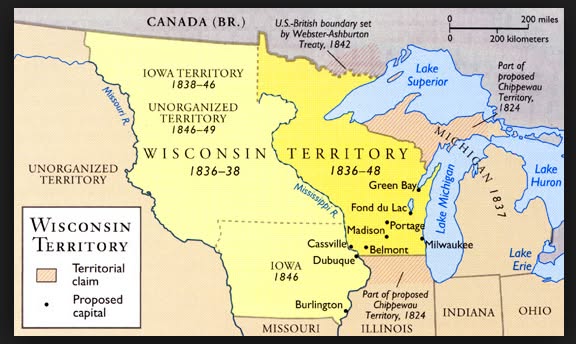
Wisconsin Territory was created by an act of Congress in 1836. The new territory at first included all of present-day Wisconsin, Minnesota, and Iowa, as well as parts of North and South Dakota.
Wisconsin Territory at one time included the Upper Peninsula of Michigan. That land was given to Michigan in exchange for what is known as the Toledo Strip which was given to Ohio.
1763
The Founding Fathers’ Vision of Expansion
Wisconsin’s path to statehood began prior to the Revolutionary War, driven by the Articles of Confederation and the Founding Fathers’ vision for expanding the nation.
1763: Britain Gained Control of the Region Following the French and Indian War
Great Britain won the French and Indian War, ending the conflict with the 1763 Treaty of Paris. Under the terms of the agreement, France gave up its claims to the region, leaving Britain in control of a vast new empire in North America. This territory included lands in the Ohio Country, Illinois Country, and the Great Lakes Region.
The Proclamation of 1763 Closed the Northwest Territory to American Expansion
Pontiac’s Rebellion underscored Britain’s weak hold on its new territory.
Faced with massive debts incurred by fighting the French and Indian War, Britain had no desire to become embroiled in prolonged warfare with Native Americans to protect colonists eager to settle the Ohio Country.
As a result, King George III issued the Proclamation of 1763 on October 7th, reserving the lands west of the crest of the Appalachians for the native inhabitants and forbidding colonists from settling in the area.

Pontiac’s War Summary: Native American Resistance Against British Rule
Pontiac’s War: The Native Rebellion That Shook Britain
1781 – 1783
From the Articles of Confederation to the Paris Peace Treaty

Prior to 1781, Ratification of the Articles of Confederation Was Delayed
Western land claims: States like Virginia and New York claimed vast tracts of land west of the Appalachian Mountains based on colonial charters.
The Maryland holdout: States without western land claims, most notably Maryland, refused to approve the Articles. They feared that states with huge western territories would grow too large and powerful.
The resolution: Maryland finally ratified the document on March 1, 1781, only after larger states agreed to cede their western claims to the national government.
1783: Britain Ceded the Territory to the United States
The United States and Great Britain agreed to The Paris Peace Treaty of 1783, which ceded all the land east of the Mississippi River, north of Florida, and south of Canada to the United States, excluding the City of New Orleans. This included the Northwest Territory.

Year in Revolution 1783: Treaty of Paris
1787
The Ordinance of 1787, or Northwest Ordinance
The Blueprint for Governing the Northwest Territory
In 1787, Confederation Congress adopts a plan called The Ordinance of 1787. The Northwest Ordinance calls for new states to be developed in the Ohio region.

Americans moving into the Northwest Territory began petitioning Congress to provide a plan for self-government in the region.

The Northwest Ordinance
On July 13, 1787, the Confederation Congress enacted “An Ordinance for the Government of the Territory of the United States, North-West of the River Ohio, 1787,” more commonly known as the Northwest Ordinance.
- Established a three-stage process for creating new states in the Northwest Territory.
- Created a Bill of Rights for Americans living in the Northwest Territory.
- Prohibited Slavery in the Northwest Territory.
- Affirmed the “good faith” of the United States toward Indians and their lands.
The Old Northwest
The Northwest Territory Covered Portions of 5 States
The Northwest Territory, also known as the Old Northwest, included an estimated 260,000 square miles that included the present-day states of: Ohio, Indiana, Illinois, Michigan, Wisconsin, and Minnesota.
All the land in the first five states was in the Northwest Territory and the eastern portion of Minnesota.

Order of States Created from the Territory
Five full states and part of another were eventually carved out of the Northwest Territory. It is also important to note that all six states were “Free States” that did not allow slavery.
- Ohio became the 17th state admitted to the Union on March 1, 1803.
- Indiana became the 19th state admitted to the Union on December 11, 1816.
- Illinois became the 21st state admitted to the Union on December 3, 1818.
- Michigan became the 26th state admitted to the Union on January 26, 1837.
- Wisconsin became the 30th state admitted to the Union on May 29, 1848.
- Minnesota became the 32nd state admitted to the Union on May 11, 1858.
1639 – 1848
Chronology of Wisconsin from 1639
Chronology of Wisconsin from 1639 to 1843. Source: Chapter 2 of “An Illustrated History of the State of Wisconsin: being a complete civil, political and military history of the state from its first exploration down to 1875” by Charles Richard Tuttle, published 1875. Transcribed and donated by Andrea Stawski Pack.
- 1639. The country as far as the head of the Wisconsin River was explored by Nicolet.
- 1654. The territory now embraced within the limits of the State in the vicinity of Green Bay was occupied by fur-traders.
- 1660. Rend Menard explored the country to Chegoimegon Bay, Lake Superior, where a mission was afterwards established.
- 1661. The same traveler crossed the country from Lake Superior to Black River Falls.
- 1664. The French minister officially orders, or grants, the sale of brandy and other liquors to the Indians.
- 1665. Claude Allouez, an eminent pioneer missionary, established a mission at La Pointe, Lake Superior.
- 1667. Louis Nicholas joined Allouez at the mission at La Pointe.
- 1669. Father Allouez established a mission at Des Peres, or Green Bay. This mission was at the Rapids of Depere, a short distance above the present city of Green Bay.
- 1670. Father Allouez made a voyage of the Fox and Wisconsin Rivers to within a short distance of the Mississippi, – a near approach to the discovery of the Father of Waters.
- 1671. In this year the French took formal possession of the whole North-west.
- 1673. Father James Marquette discovered the Mississippi River.
- 1674. The same explorer coasted Lake Michigan, from Green Bay, by Milwaukee, to the site of the present city of Chicago.
- 1676. Father Allouez made a voyage to Chicago by Milwaukee.
- 1679. “The Griffin,” a schooner built by La Salle, and the first to make a voyage of the lake above the Niagara, arrived at Green Bay.
- 1679. La Salle made a voyage on Lake Michigan, from Green Bay to the St. Joseph River.
- 1679. Capt. Du Lath held a council, and concluded a peace with the natives of Lake Superior.
- 1680. Tonti established a military port and garrison at Green Bay.
- 1681. Marquette’s journal and map of his travels and explorations in the North-west were published in France.
- 1683. Le Sueur made a voyage of the Fox and Wisconsin Rivers to the Mississippi.
- 1685. Durantaye erected a fort at Checagua.
- 1688. Fort St. Nicholas was built at the mouth of the Wisconsin.
- 1688. La Hontau made a voyage through the country, making valuable observations.
- 1688. Parret established a trading-station on Lake Pepin.
- 1688. Fort St. Antoine was erected at the mouth of the Chippewa River.
- 1688. A military port named Beauharnois was erected on the north side of Lake Pepin.
- 1695. Le Sueur built a fort on an island in the Mississippi, below the St. Croix.
- 1699. John Buisson de St. Comes made a voyage of Lake Michigan, stopping at Milwaukee.
- 1700. Le Sueur made a voyage up the Mississippi in search of copper ore.
- 1714. Le Louvigny’s battle with the Fox Indians at Butte des Morts.
- 1719. Francis Renalt explored the Upper Mississippi with two hundred miners.
- 1721. P. de Charlevoix made a journey through Wisconsin.
- 1726. A French fort was established at Green Bay.
- 1727. The French established a fort on Lake Pepin, with Sieur de Lapperriere commandant.
- 1728. There was a great flood in the Mississippi; and Fort Beauharnois was submerged.
- 1728. A French expedition, under De Lingnery, from Green Bay, punished the Foxes.
- 1734. A battle took place between the French, and the Sauks and Foxes.
- 1745. Green Bay was settled by Augustus and Charles De Langlade.
- 1747. Capt. De Vorcheres takes command at Green Bay.
- 1764. Sieur Martin, in command at Green Bay, makes a peace with the Indians.
- 1755. A French post, or fort, was established at Prairie du Chien.
- 1760. Capt. Balfour and Lieut. Gorrell, with English troops, took possession of Green Bay.
- 1762. A deputation of Indians went from Milwaukee to Green Bay to complain of dishonest traders.
- 1763. The English, under Lieut. Gorrell, abandon Green Bay in consequence of the approaching Indian war.
- 1763. The great Pontiac war.
- 1763. Treaty of Paris, by which all the territory of New France, including Wisconsin, was surrendered to the English.
- 1764. Green Bay re-occupied by the British under Capt. Howard.
- 1764. Louisiana ceded to Spain by the French.
- 1766. The laws of Canada were extended over the northwest.
- 1766-68. Jonathan Carver makes an extended tour through the country.
- 1774. Organization of the North-western Fur Company.
- 1774. A civil government was established in the North-west, by the celebrated ” Quebec Act.”
- 1777. Indians from Wisconsin joined the British against the Americans.
- 1780. Lieut.Gov. Patrick St. Clair of Canada purchased Green Bay, Prairie du Chien, & c., from the Indians.
- 1785. There was a great flood in the Mississippi River.
- 1786. Julian Dubuque explored the lead region of the Upper Mississippi.
- 1787. The well-known Ordinance of 1787 was passed by Congress for the government of the North-west.
- 1788. There was an Indian council at Green Bay. Permission to work the lead mines was given to Dubuque.
- 1796. Green Bay, Prairie du Chien & c., were surrendered by the English to the United States.
- 1796. Laws of the Ordinance of 1787 extended over the North-west.
- 1800. Indian territory organized, including Wisconsin.
- 1800. Louisiana ceded to France by Spain.
- 1803. Antoine Barth settled at the portage of the Fox and Wisconsin Rivers.
- 1803. Louisiana ceded to the United States by France.
- 1804. Indian treaty at St. Louis; Southern Wisconsin purchased.
- 1805. Michigan Territory organized.
- 1805. Lieut. Pike ascended the Mississippi River.
- 1809. Thomas Nuttall, the botanist, explored Wisconsin.
- 1809. Illinois Territory was organized, including Wisconsin.
- 1809. First saw-mill built, near Green Bay.
- 1812. Indians assembled at Green Bay to join the English.
- 1814. Gov. Clark took possession of Prairie du Chien.
- 1814. Prairie du Chien surrendered to the British.
- 1815. The American Fur Company began to establish trading-posts.
- 1815. United States trading-post established at Green Bay.
- 1816. Indian treaty confirming that of 1804.
- 1816. United States troops took possession of Prairie du Chien.
- 1816. Col. Miller commenced the erection of Fort Howard at Green Bay.
- 1816. Indian treaty; lands relinquished to Indians.
- 1816. Jaques Vieux settled at Milwaukee.
- 1817. Indian treaty at St. Louis.
- 1817. Major S. H. Long ascended the Mississippi.
- 1818. State of Illinois was organized; Wisconsin attached to Michigan.
- 1818. Dec. 3. Illinois, became the twenty-first state of the Union.
- 1818. Solomon Juneau built his cabin.
- 1818. A saw-mill built four miles above Prairie du Chien.
- 1818. Brown and Crawford Counties organized, including the whole State.
- 1819. A saw-mill erected at Black River Falls, by C. A. Andrews.
- 1819. Fort Snelling built and occupied.
- 1820. United-States commissioners adjusted land-claims at Green Bay.
- 1821. Oneida and Stockbridge Indians settled near Green Bay.
- 1821. First post-office established at Green Bay.
- 1821. Fort Crawford built at Prairie du Chien.
- 1822. The New York Indians purchase lands east of Lake Winnebago.
- 1822. James Johnson obtained from the Indians the right to dig for lead by Negro slaves from Kentucky.
- 1823. January. Wisconsin made a separate Judicial District by Congress.
- 1823. First government leases to lead-miners.
- 1823. Land-claims at Prairie du Chien adjusted by the government.
- 1823. Major S. H. Long’s expedition to the Upper Mississippi.
- 1823. First steamboat on the Upper Mississippi, with Major Taliafero and Count Beltrami.
- 1823. Lieut. Bayfield of the British navy made a survey of Lake Superior.
- 1823. An Episcopal mission established near Green Bay.
- 1824. James D. Doty appointed judge by Pres. Monroe; held the office nine years.
- 1824. July 12. First court held in Brown County.
- 1824. Oct. 4. First term of United-States Circuit Court held at Green Bay.
- 1825. Aug. 1 and 19. Indian treaties at Prairie du Chien.
- 1825. The Carver grant of land rejected by Congress.
- 1826. First steamboat on Lake Michigan. 1826. Indian treaty at St. Louis.
- 1826. Great flood in the Mississippi, twenty-six feet above low water at Prairie du Chien.
- 1827. A rush of speculators to the lead-mines.
- 1827. Difficulties with the Indians. Troops sent to settle them.
- 1827. Aug. 11. Treaty with the Menomonee Indians at Butte des Morts.
- 1828. Fort Winnebago built at “the portage.”
- 1828. Indian treaty at Green Bay; the lead-region purchased.
- 1828. Lead ore discovered at Mineral Point and Dodgeville.
- 1829. July 29. Winnebago treaty at Prairie du Chien.
- 1829. A Methodist mission established at Green Bay.
- 1830. A Methodist mission established at La Pointe.
- 1830. May. The Sioux killed seventeen Sauks and Foxe3 near Prairie du Chien.
- 1831. Feb. 8. Menomonee treaty at Washington.
- 1831. Public lands in the lead-region surveyed by Lucius Lyon and others.
- 1832. June 16. Battle with the Sauk Indians on the Pekatonica.
- 1832. July 21. Battle on the Wisconsin River.
- 1832. Aug. 2. Battle at mouth of the Bad Axe; Black Hawk defeated.
- 1832. First arrival of steamboat at Chicago.
- 1832. Schoolcraft discovered the true source of the Mississippi.
- 1832, Sept. 15. Winnebago treaty at Fort Armstrong.
- 1832. Oct. 27. Treaty with the Menomonees.
- 1832. High water in the Mississippi.
- 1833. A Methodist mission established at Ottawa Lake (Chippewa River).
- 1833. Sept. 26. Indian treaty at Chicago ; lands south and west of Milwaukee ceded to the government.
- 1833. Dec. 11. First newspaper (“Green Bay Intelligencer”) published.
- 1834. Public lands near Green Bay surveyed by A. G. Ellis.
- 1834. Land offices established at Mineral Point and Green Bay.
- 1834. Population by census taken, 4,795.
- 1835. First settlement at Milwaukee, Samuel Brown and family.
- 1835. George W. Jones elected delegate to Congress.
- 1835. J. N. Nicollett commenced scientific exploration.
- 1835. Public lands at Milwaukee surveyed by William A. Burt.
- 1836. Jan. 9. The legislative council of Michigan met at Green Bay.
- 1836. April 30. Henry Dodge appointed governor by Pres. Andrew Jackson.
- 1836. July 4. Territory of Wisconsin organized.
- 1836. July 14. “Milwaukee Advertiser” published at 371 Third Street.
- 1836. Sept. 3. Treaty with the Menomonee’s at Green Bay.
- 1836. Oct. 10. George W. Jones elected delegate to Congress.
- 1836. Oct. 25. First legislature of Wisconsin convened at Belmont, Wisconsin.
- 1836. Dec. 3. Seat of government established at Madison.
- 1836. First school opened in Milwaukee (at No.371 Third Street).
- 1836. United States land-office opened at Milwaukee.
- 1837. Jan. 26. Michigan admitted as the twenty-six state of the union.
- 1837. July 29. Chippewa treaty at Fort Snelling.
- 1837. Sept. 29. Sioux treaty; lands east of the Mississippi ceded.
- 1837. Nov. 1. Winnebago treaty; lands ceded.
- 1837. Nov. 6. Legislature met at Burlington, Iowa.
- 1838. June 11. Special session of the legislature at Burlington, Iowa.
- 1838. Sept. 10. James D. Doty elected delegate to Congress.
- 1838. Nov. 26. First session of the legislature at Madison.
- 1839. Jan. 21. Legislative session; statutes enacted.
- 1839. Indian (Sioux and Chippewa) battle; two hundred killed.
- 1839. September. James D. Doty re-elected to Congress.
- 1839. Dec. 6. Legislative session commenced.
- 1840. Aug. 3. Extra session of the legislature.
- 1840. Dec. 7. Legislative session.
- 1841. Sept. 27. Henry Dodge elected delegate to Congress.
- 1841. Sept. 30. James Duane Doty appointed governor by Pres. John Tyler.
- 1841. Dec. 6. Legislature met.
- 1842. Oct. 4. Chippewa treaty at La Pointe; lands ceded.
- 1842. Dec. 6. Legislative session commenced.
- 1843. Sept. 25. Henry Dodge re-elected delegate to Congress.
- 1843. Dec. 4. Legislative session commenced.
- 1844. June 21. Nathaniel P. Tallmadge appointed governor by Pres. John Tyler.
- 1845. Jan. 6. Legislative session commenced.
- 1845. April 8. Henry Dodge appointed governor by Pres. James K. Polk.
- 1845. Sept. 22. Morgan L. Martin elected delegate to Congress.
- 1846. Jan 5. The legislature met.
- 1846. April. A vote of the people in favor of a State government.
- 1846. Aug. 6. Act of Congress authorizing a State government.
- 1846. Dec. 16. A State constitution adopted in convention.
- 1847. Jan. 4. The legislature met.
- 1847. April. The proposed State constitution rejected by vote of the people.
- 1847. Sept. 27. John H. Tweedy elected delegate to Congress.
- 1847. Oct. 18. Special session of the legislature.
- 1848. Feb. 1. A new State constitution adopted in convention.
- 1848. Feb. 7. Sixteenth (and last) session of the Territorial Legislature.
- 1848. March 13. The State constitution adopted by a vote of the people; and Wisconsin became one of the States of the American Union, being the seventeenth admitted, and the thirtieth in the list of States.
“An Illustrated History of the State of Wisconsin…” by Charles Richard Tuttle, 1875. Transcribed and donated by Andrea Stawski Pack. © Genealogy Trails